
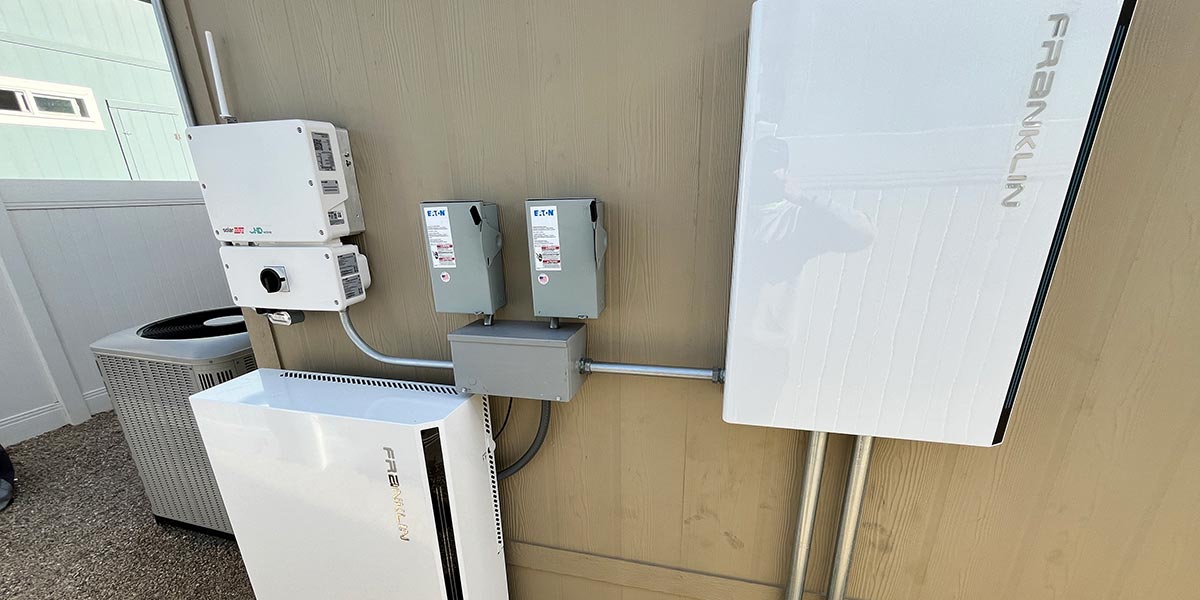
How to Size Your Battery Correctly in NEM 3.0
If you’re considering solar in Southern California under NEM 3.0, the biggest mistake you can make is undersizing your battery. The new net billing structure has completely changed how your system interacts with the utility, and now more than ever, battery sizing isn’t just about backup power — it’s about maximizing your savings.
In this guide, we’ll walk through exactly how to size your battery the right way under NEM 3.0 and for solar energy systems in the Palm Desert area. We’ll cover how to evaluate your energy usage, how to account for seasonal and time-of-use patterns, and how to use the right solar-to-storage ratio to achieve true bill reduction — not just export credits that get wiped out at low rates.
Why Battery Sizing Matters Under NEM 3.0
Under California’s previous NEM 1.0 and 2.0 programs, the utility credited you close to retail value for excess energy sent to the grid. Batteries were optional — nice to have for backup, but not mandatory for savings.
Under NEM 3.0, that’s changed. Now, exported solar is credited at the “Avoided Cost Calculator” rate, often between $0.04 and $0.08 per kWh — far below what PG&E or SCE charges to buy back that same power. That means exporting to the grid is no longer a winning strategy.
Instead, storing your solar power in a battery and using it when the sun goes down (especially during peak utility rates) is now the only way to truly save. But to do that effectively, you need to size your battery correctly — and that starts with understanding your energy habits.
Step 1: Understand Your Annual Energy Usage
The first thing we do when designing a solar-plus-battery system is look at your annual consumption. You can usually find this on your utility bill or by pulling data from PG&E or SCE online.
For most homes in Fresno, Clovis, or the Coachella Valley, annual consumption is not evenly distributed. Instead, we typically see:
- 8 months of lower usage
- 4 months of high usage during peak summer due to air conditioning
This seasonal imbalance plays a major role in how your system should be sized. For example, a home using 10,000 kWh per year might use only 500 kWh in cooler months but jump to 1,200–1,500 kWh during summer.
That jump must be accounted for when planning both solar production and battery storage.
Step 2: Break Down High vs Low Demand Months
Understanding the difference between your low and high usage months helps us avoid underbuilding your system. If we only size your battery based on average usage, you’ll fall short in the summer — exactly when rates are highest, and the need for battery discharge is greatest.
Let’s say your summer usage is double what it is during the rest of the year. We use that spike to set the high-water mark for battery design. Even if you don’t fully cycle the battery every day in spring or fall, the oversized storage ensures you’re covered when it counts — during the blazing hot July and August afternoons when AC demand peaks and export rates plummet.
Step 3: Analyze Daytime vs Nighttime Usage
The next layer of analysis is looking at when you use your electricity.
We break usage into two primary windows:
- Daytime usage (covered by solar)
- Nighttime usage (must be covered by stored battery power or grid)
A household that is mostly empty during the day but ramps up electricity use in the evening will need a larger battery relative to their solar size. On the other hand, a home with daytime loads — EV charging, pool pumps, appliances, etc. — may need more solar production to handle those real-time demands.
Knowing your daily load shape helps us balance your system properly and reduce grid dependence.
Step 4: Oversizing the Solar System (120%–130% Target)
In NEM 3.0, it’s not enough to offset your annual consumption 1:1, because you’re no longer getting full retail value for your exported power, you need to overproduce to cover:
- High summer usage
- Battery charging needs
- Export losses
That’s why we aim to size your solar system to produce 120% to 130% of your annual electricity usage.
Why not more?
If you go too far beyond 130%, you’ll likely overproduce in the spring and fall when consumption is low — and most of that excess will get dumped onto the grid for pennies on the dollar. There’s a sweet spot where you generate enough to cover your high months and battery charging, but not so much that you waste production.
Step 5: How to Use the Sizing Ratio (2.5 to 3 kWh per 1 kW Solar)
Once we’ve established your solar system size, we move to battery sizing. This is where the most common mistake happens: people install too little storage.
The golden rule we’ve found through hundreds of NEM 3.0 projects is this:
For every 1 kW of solar, you need 2.5 to 3 kWh of usable battery capacity.
Let’s break that down:
- · 10 kW solar system → 25 to 30 kWh battery
- · 15 kW solar system → 37.5 to 45 kWh battery
This ratio ensures you can store enough solar power each day to:
- Run your home at night.
- Minimize or eliminate peak-hour grid usage.
- Charge fully and discharge consistently (maximizing your ROI)
This ratio is based on usable capacity — not nameplate rating. For example, a battery rated at 13.5 kWh might only provide 12.2 kWh of usable power. Always use usable capacity for your calculations.
What This Looks Like in Real Homes
Let’s take an example from a real customer in Fresno:
- Usage: 12,000 kWh annually
- Solar system: 13.5 kW (sized at 125% of usage)
- Battery storage: 36 kWh usable (3x ratio)
This homeowner had four months of 1,200+ kWh usage in summer and only 500–600 kWh the rest of the year. With this system:
- They avoided 95% of grid usage.
- Their True Up bill was nearly eliminated.
- Their monthly cost (solar loan + small utility bill) dropped 50%
Without that battery size, they would’ve exported excess power during the day — only to buy it back later at peak rates. With the right ratio, they stored their solar energy and used it when it mattered most.
The Goal: Less Than 5% Grid Usage
That’s our benchmark for success: under 5% grid usage.
If you’re still relying on the grid every night or during summer spikes, your savings will take a hit. PG&E and SCE have no incentive to buy your power high and sell it back low — so we don’t give them the opportunity.
With the right battery size and solar-to-storage ratio, your home becomes a microgrid. You generate, store, and use your own power on your own terms.
Cutting Costs by 50% with the Right Pairing
When your battery is properly sized, you get real financial results.
Here’s what we typically see for California homeowners under NEM 3.0 when we follow this strategy:
- Grid reliance drops to 3%–5%
- Electricity costs drop 40% to 60%
- True Up bill nearly disappears.
- Battery charges and discharges daily, maximizing its value
Pair that with the 30% federal tax credit, and you’re looking at a system that pays for itself while giving you more control and backup capability.
Summary: NEM 3.0 Battery Sizing Done Right
Let’s recap the formula:
- Start with annual usage.
- Account for high and low months (AC-driven spikes)
- Break usage into daytime vs nighttime
- Size solar to 120%–130% of annual demand
- Size battery using a 2.5–3.0 kWh per 1 kW solar ratio
- Target under 5% grid reliance
This is the blueprint we use at Supreme Solar and Electric across California — from Fresno to Palm Desert and the Coachella Valley. It’s how we’ve helped hundreds of families lower their energy costs, gain independence from the utility, and build solar systems that actually work under NEM 3.0.
Get Help Sizing Your Solar Battery from Supreme Solar
Schedule a free design consultation with the Supreme Solar team, and we’ll walk you through your exact numbers. No fluff. Just real savings. Our Palm Desert solar energy system experts can help you with battery sizing, getting the most out of your solar energy system, and critical backup for your home.
Let us know when you’re ready to take control of your power.