
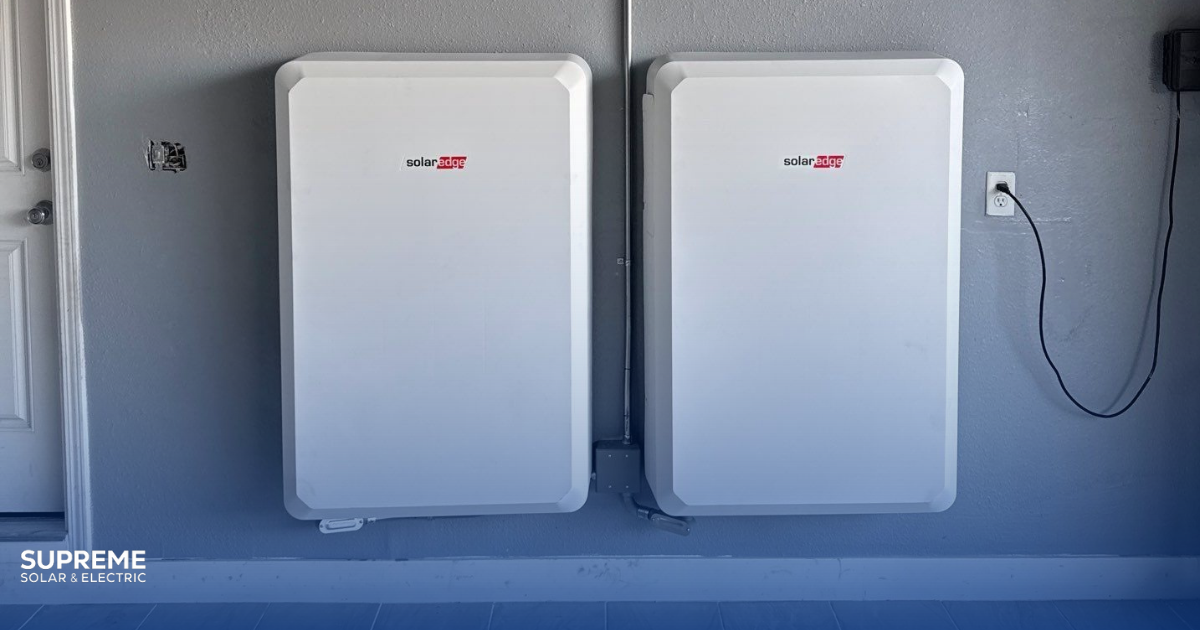
If you’re considering solar in Palm Desert in 2026, one of the biggest decisions you’ll make is whether to include battery storage. Several years ago, batteries were primarily an optional upgrade for homeowners who wanted backup power. Today, batteries also play an important role in managing solar electricity under California’s current utility rate structures.
Does every homeowner need the same battery setup? No. The value and size of a battery depend on your net metering agreement, when you use electricity, how much excess solar you produce, and whether backup power is important to you.
For most homeowners, battery storage provides two primary benefits: reducing utility costs through better energy management and providing backup power during outages.
How Does a Solar Battery Work?
Solar panels produce electricity during daylight hours, but that isn’t always when your home needs the most power. Solar production is generally strongest during the middle of the day. Household electricity consumption, however, can increase later as people return home, run air conditioning and appliances, cook dinner, and charge electric vehicles.
Without a battery, excess daytime solar electricity is typically exported to the grid. When solar production declines, the home purchases electricity from the utility. A battery allows you to store some of that excess solar production and use it later. Instead of exporting electricity when its value may be relatively low and purchasing more expensive electricity later, you can shift your solar energy to the time when it provides greater value. This process is often called energy arbitrage. You’re not producing more electricity; you’re making better use of the electricity your solar system already generates.
Battery Storage for NEM 2.0 vs. NEM 3.0
Battery strategy can differ significantly depending on whether you have an existing NEM 2.0 system or a newer system under NEM 3.0, also known as Net Billing. Under NEM 2.0, exported solar electricity receives credits based on the applicable Time-of-Use structure. Because homeowners could use these credits to help offset electricity purchased later, many NEM 2.0 systems were originally installed without batteries.
However, the difference between peak and off-peak electricity rates can make battery storage valuable even for existing NEM 2.0 customers. For many homeowners, the important peak period is approximately 4 PM to 9 PM.
A battery can charge using solar production during the day and discharge during this more expensive period. If financial savings are the primary goal, the battery may not need to power the home throughout the entire night. Its job may simply be to reduce the amount of higher-cost electricity purchased during peak hours.
Under NEM 3.0, battery storage can play an even larger role. Export compensation varies based on factors such as the time, day, month, and season, and daytime solar exports can sometimes receive relatively low compensation. For this reason, modern solar and battery systems often prioritize: Home first. Battery second. Grid third.
Solar powers the home during the day, excess production charges the battery, and stored energy is used after solar production declines. This increases self-consumption and reduces the amount of electricity that needs to be purchased from the utility. Because NEM 3.0 systems may rely on stored solar energy for a longer portion of the evening or night, they can also require more battery capacity than a NEM 2.0 system designed primarily to offset peak-period electricity.
Your Energy Habits Determine Battery Size
There isn’t one battery size that’s right for every home. Two houses with identical solar systems can have very different storage needs. A homeowner who works from home, runs appliances during daylight hours, and charges an EV while solar is producing may consume much of their solar electricity immediately.
A household that’s empty during the day but uses significant electricity at night may benefit more from battery storage because more daytime solar production needs to be shifted into evening hours. That’s why battery sizing should be based on your home’s actual energy profile rather than simply its square footage or a standard number of batteries.
Your solar contractor should consider how much electricity you consume after sunset, how much excess solar you generate during the day, your net metering agreement, and whether the battery is primarily intended for savings, backup power, or both.
Battery Storage Can Provide Backup Power
Battery storage can also provide something solar panels alone typically cannot: electricity during a utility outage. Traditional grid-tied solar systems generally shut down when the utility grid goes offline. This prevents electricity from being sent back onto utility lines while crews may be working on them.
With the appropriate equipment, a solar and battery backup system can isolate the home from the utility during an outage and continue supplying electricity to selected household loads.
How much backup you need affects the size and design of the system. Some homeowners only want to keep essentials such as the refrigerator, lights, internet, outlets, garage door, or well pump operating. Others want something closer to whole-home backup, including air conditioning and additional appliances.
The greater the electrical demand during an outage, the more battery capacity and power capability the system will require.
Solar Extends the Value of Battery Backup
Pairing battery storage with solar provides another important advantage during extended outages: the battery can recharge. If an outage begins at night, the battery can provide stored electricity until solar production resumes the following morning. Solar can then power the home while replenishing the battery for later use.
This cycle can continue as long as solar production and household electricity consumption remain appropriately balanced. That’s why designing a backup system requires looking at solar production and battery storage together rather than considering battery capacity alone.
Is Battery Storage Worth It in California?
Homeowners in the Palm Desert area are finding that battery storage can be worthwhile even if power outages are uncommon because today’s batteries aren’t only backup systems. They can actively manage electricity every day. For an existing NEM 2.0 homeowner, a battery may primarily help reduce purchases of expensive electricity during peak Time-of-Use periods.
With a new NEM 3.0 solar system, battery storage can help increase self-consumption by storing excess daytime solar production for use later rather than relying heavily on utility exports.
Batteries can also provide backup power for homeowners concerned about outages. If you want both utility savings and substantial backup capability, the system should be sized around both objectives.
At Supreme Solar and Electric, we consider the homeowner’s net metering agreement, solar production, daytime and nighttime electricity consumption, utility rates, backup requirements, and overall goals when determining how much battery storage makes sense.
Ultimately, the biggest advantage of a solar battery isn’t simply its ability to store electricity. It’s the ability to give you greater control over when and how the electricity your solar system produces is used.